Sunday, November 25, 2012

Deeper Into The Narrative

It's taken a long time, but I've finally digested some of the advice I got from an editor on how to improve this story, Aurora's Dreams. I have been afraid of revealing too much character. I was trying to establish archetypes without describing the lives of these characters in much detail. I've changed my mind. I was afraid of becoming too autobiographical, but story is what readers come for, and I know I must give it to them. It's surprising though. The deeper I go into the narrative the more difficult (read, painful) it gets. I guess that's good on some level.

So here is the first part of a newly written scene that reveals a bit more about the life of Sunny, the Fat Whore of Babylon.

The jangling ring of the telephone woke her with a start and blindly, she reached for the handset. It was “Stormy” the famous madam Sunny sometimes worked for. Stormy had a light, yet cajoling way about her that was very hard to refuse.  “Sunny, how are you darling? Keeping busy?” Sunny’s head felt heavy, her thoughts crawled like thick honey soaking through stodgy pudding, her eyes refused to open. “Mmm, I’m fine, thank God. How about yourself Stormy?” “You know me, never a dull moment, but I can’t complain… Listen, how would you like to do a little job for me? It would mean a lot, you see it’s a very special client and you’re the only one I trust with my special ones. OK?”


Sunny was feeling too tired to negotiate the terms. She didn’t realise that she’d agreed to anything when Stormy said, “Fine, he’s at a place across town and he’s waiting, and I haven’t got a driver so call a cab, get yourself in the shower and get over there. I’ll tell him you’re on your way, OK honey? That’s my Sunny!” Sunny was sitting up by now and only as she wrote down the address did she realise what she had agreed to do. The client was a new guy, and judging by his hotel, an out of towner. She fought to push down the fears that were rising in her stomach. She called the cab and stumbled towards the shower. It was only ten o’clock in the morning for God’s sake!


The cab ride seemed to take forever. It was almost eleven when she knocked on the door. She roused a smile and hoped for the best. The door was opened by a tall, skinny, weathered man in his late fifties wearing work shorts, an old fashioned cotton short sleeved shirt and dark socks. A farmer from the country. His wiry arms and deeply lined face had the look of a dry river bed. His pale eyes darted one way and another, squinting as the sunlight entered the room. That was the last time she saw his eyes. 


Sunny introduced herself, he didn’t reply, instead he headed to the bed and lay down on top of the covers. “How are you today?” she said as she moved toward the desk. “You’re late. I’ve been waiting since ten o’clock! I’ve got things to do today!” he complained. Momentarily taken off guard Sunny apologised, “I’m sorry, I came as quickly as I could. There was no driver and the taxi took ages to find my place…” He cut her off, “I’ve got a good mind not to pay for this kind of service, get on with it!”


She felt a lump in her throat and her mouth went dry. It was hard to speak but she had to bring up the money.


“Did Stormy say how much it was?”


“Yeah, $60, the money’s on the table. Should be half price at this rate…”


Sunny saw the cash as she got down to her underwear as quickly as she could and placed her clothes on the back of the chair. He was still lying on his back with his clothes on and his eyes closed. She was afraid that if he didn’t pay her she’d have paid the taxi and would still have to pay Stormy. She had to calm him down and make sure he got what he wanted.


She would dream of going to America, not to find her father, he could rot in hell for all she cared; she would be taken away from all this dirt and desperation by a wonderful man who would adore her and take pity on her.


She lived for music and so she sought out the music of America, jazz, as a wistful traveller might read about far away places. America sang a siren song that reached out to her through the unmistakable voice of Billy Holliday. Those sad songs struck a chord deep within her even if she couldn’t understand every word. She drank in every drop of pain, cried every tear and then, slowly, wiping her eyes and brushing back her hair, lifted up her head in defiance.


I haven't written the conclusion to that scene. I have to work up the nerve. Maybe next week.

Thursday, April 5, 2012

Leaving the Village Behind

Have you ever felt alone in a crowd, isolated though you are the centre of attention? Have you longed for social success, fame, status, only to be disillusioned when you found yourself obliged to subscribe to a club whose members didn't really know you? Have you experienced joy while still searching for truth? Worldboy feels like this. He needs to replenish his spirit, unfortunately he doesn't get the nourishment he needs from those around him. He needs to escape to the country. He's going crazy at this party, it's too loud, it's too late, there are too many people needing his attention, too many people shaking his hand, placing their hands on his shoulder demanding that he smile back.

The misty, quiet, dark forest is calling him.

The story of Worldboy is a long traveller’s tale about escapism. He is not really going anywhere in particular; rather he is running away. He is an astronaut, the ultimate runaway. The classic runaway story always ends in Hollywood and Worldboy knows he’s a star. Sadly, this story often ends in loneliness and ruin too.

Why is he running away? Essentially, because as a child, his boundaries were violated. He was manipulated, stripped of his right to essential privacy and respect. His parents didn’t give him the space to grow into his own person, unmolested, unpunished, confident and yet still open. So he disappeared into a black hole in his mind only to emerge much later as a remote, unreachable star.

He is beautiful and talented but he is more the magician than the artist because he is afraid of his own original gifts and would rather play with perceptions and manipulate reality than put his true self under the spotlight. Sadly this myth making leaves him suffering a sense of unreality, that no one really knows him. All the applause and appreciation is valueless because he knows that he has cleverly manipulated his audience with mirrors, showing them only a brilliant reflection of themselves. He is not really the star skipping down the yellow brick road; he is the shy, fearful man behind the curtain, manipulating the machinery.

Nobody knows him, though they might think they do, and he feels he’s lost touch with himself. He feels as though he’s in an endless orbit, his feet never touch the ground. He’s been everywhere but he’s going nowhere. His endless travelling and vast knowledge of the world have inspired him and filled his heart with beauty and his mind with wonder, which he longs to share with someone but is too afraid to. His being so out of reach has become a trap. Having once had his privacy violated, he has locked the door and thrown away the key. He hates to be pinned down, to commit to someone. He is shy of obligations, careless and distrustful. He’ll make you wait, he’ll make excuses, he’ll be delightful but evasive. He is an actor and to him, you are mere scenery. He perceives other people as weak and needy so he tears away their clutching hands and shrugs off their embraces. You will soon find he has discarded you like old clothes. He is numb; to you he seems cold or selfish. He is vain but self-conscious. Beauty and luxury are the fuels that keep him going. He loves beautiful things, spends a lot but saves little. He values what is superficial because he hates his need for love. In space no one can hear you scream. Joy that is only ever experienced alone dissolves into bitter tears and poisons the soul.

If The Defender, The Hollow Man, is a narcissist, then grandiose is perhaps a word that would apply to The Star. He doesn’t mean to be cruel but eventually he drifts away or people drift away from him. Escapism is the theme; isolation and a sense of unreality are his main complaints. He voraciously consumes experiences and excitement to feel something. He has trouble respecting your boundaries, yet he is nervous of being touched. He has a body image that is unrelated to the state of his body at any given moment and his weight and level of fitness has varied markedly over time. Mostly he feels detached from his body and wishes he were somebody else. He will fail at tasks ordinary folk find quite easy, since they respect routines and deadlines. To earn his affection you will have to pass many tests of your patience and forgiveness, he doesn’t believe you when you compliment him. He is always aware of all your faults and imperfections and will subtly remind you of them. On the other hand, if you work for him and you do exactly as he asks, devoting yourself tirelessly to achieving the best in what you do, he will adore you. He likes nothing better than top class service and is very appreciative when you have done a great job. Let him down, though, and he will never forget it. He doesn’t like to be second-guessed and hates surprises. Kindness surprises and embarrasses him. If he allows himself any introspection he will admit to feeling frozen. He has emotional stage fright. He is afraid of allowing you to really know him because he believes he has nothing to offer, (and he will be abused or abandoned again), so he prefers to act as though nobody is good enough for him.

Having suffered emotional manipulation and violation of his boundaries as a child The Star must make a commitment to pass beyond his obvious limitations. Escape is taking you away from mindfulness. It is delaying your progress. You need effective strategies to ask for what you need rather than manipulating other people, for saying no rather than lying or misleading other people, and for coping with interpersonal conflict while maintaining suitable personal boundaries and respecting the boundaries of others.

“Share the Joy” means find what you truly value in the world, and what is original and good in yourself and offer it to others without expecting anything in return, but just for the simple pleasure of openness and joyous intimacy. Use the technique of mindfulness to examine how you feel and what you truly value. (Recognise your needs and boundaries). This will take you in the opposite direction from everywhere you’ve ever been before, so it will be difficult and uncomfortable for you. Your mindfulness may last only for a second or two. You will try to escape again. Persist and you will be able to gradually tolerate longer periods of mindfulness before you are defeated by the pain. The commitment you must make is to know your boundaries and develop the self-confidence to commit to yourself and commit yourself to others rather than letting your fears control you and isolating yourself from others.”

The Moon’s lesson for us is:

Value what is real. Don’t be superficial. Vanity, envy and escape are self-defeating. Gain by sharing your true inner beauty and true genius with those who can appreciate it. Use your creativity for genuine good. You are truly original, so develop the sensitivity to inspire and manage others in a way that elevates them and brings honour to yourself. Don’t be condescending, seek out the gifts others have to offer. Stand for truth; leave liars alone. Develop genuine attachments. Value your gifts; they came from the Sun. Your joy will make you beautiful. Those who share in it will honour you.

You may be surprised to find that your gifts are not what you thought they were. You may have to apologize for your dishonesty and jealousy. If you have learned from The Defender to be authentic, you will find it easier to know what is of value in your life and experience. You will need skills to help you distinguish what is genuinely valuable in yourself and your life from what is a deception or a distraction. You will also need to apply these skills to others so that you are not wasting your efforts in trying to appeal to, or accommodate, those who don’t value your gifts and your originality. You do not need to be ashamed of what makes you different and unique. Conformity is not a virtue. Practice visualizing yourself how you would like to be. Begin by abandoning the things that have become obstacles to your achieving this vision. Perhaps you have invested too much commitment in the negative beliefs you hold for yourself and others. Changing your belief system is the first step towards changing your life. Become open to new possibilities. Commit to doing things differently. It’s what you do that counts.

It is a risk to hoist your flag and declare your commitment to something or someone. Risk it. Stand for once, naked in the spotlight without your tricks and special effects, and if need be, suffer the slings and arrows. Then don’t be afraid to reach for the ring, climb to the higher ground, don’t be content to be a crowd pleaser, stake a claim on something and risk it all. If you hear the sound of applause, even if it’s just one person, know that you deserve it. You are unique; give that gift to someone. With confidence you can be open; be vulnerable, (since you have established your boundaries), and you will be beautiful. The most beautiful thing you can do is to humbly place yourself before another and honour them with the gift of all your life experience, giving them the appreciation you had only ever given to all the beautiful objects you found throughout your journeying. Standing there, unadorned, let them touch you, for if they find you beautiful, they will take you in their arms, silently, without a word of flattery and you will not run away.

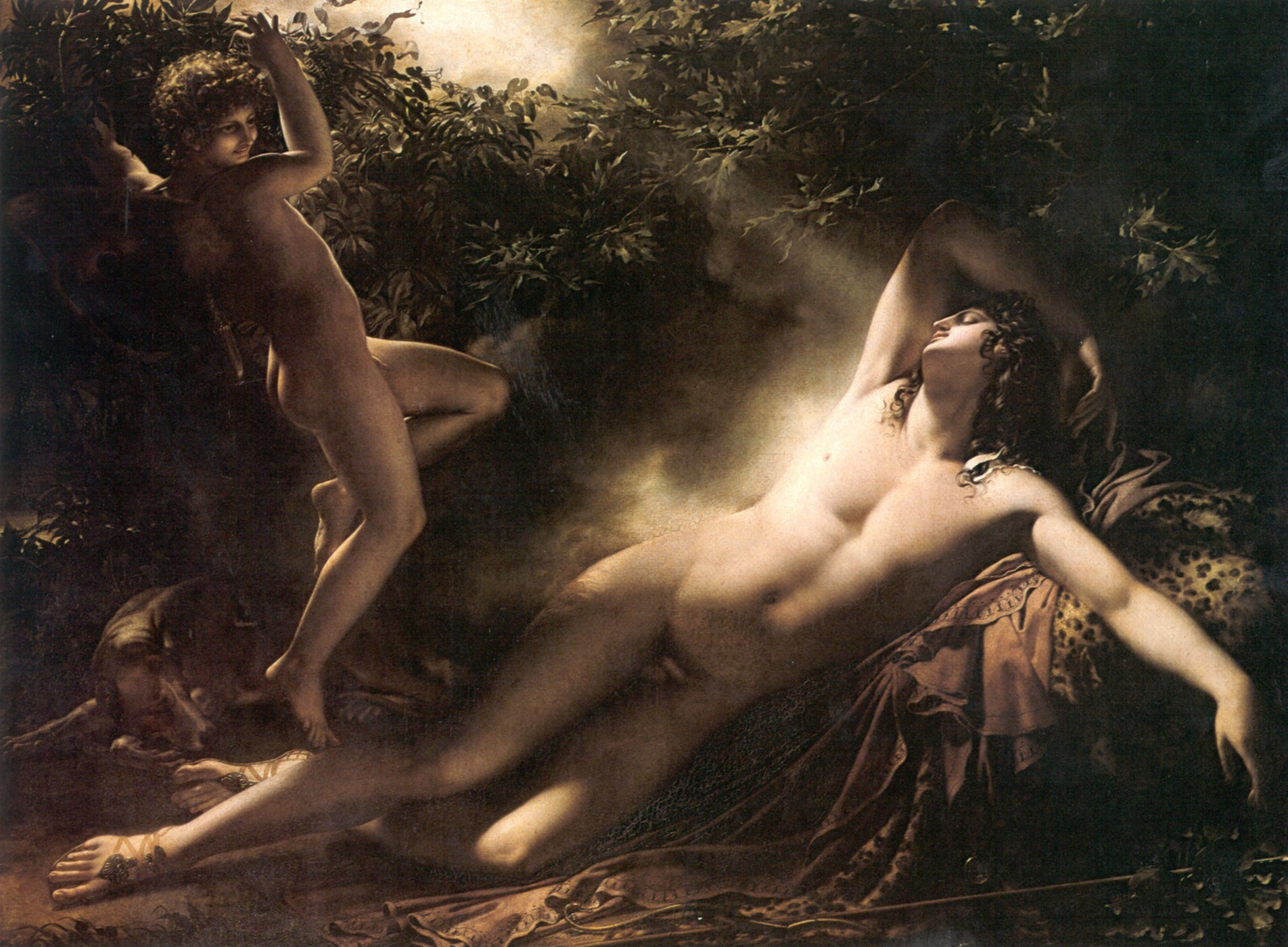
Yet the forest still calls you. To ascend to the next level, to become The Adventurer, Endymion, the hunter, the Moon's favourite, you must choose freely to leave the village and take the road into the forest, not to escape, but on a quest of discovery, not to return to the castle at the centre of the village until you have acquired the spiritual gifts hidden within the forest. The strength and wisdom you will need will be bestowed upon you by Selene, The Moon.

You will become Moonchild, Endymion, The Moon's cherished lover and a shepherd, an immortal reader of the stars, a nocturnal child of the heavens. This is your next adventure.

Monday, April 2, 2012

The Golden Calf

Last weekend Marco, The Hollow Man indulged himself at an expensive spa retreat after an arduous year of work. He enjoyed the gourmet meals and fond attentions of his hosts. By Sunday morning, after a sauna, he was sufficiently relaxed to plunge into the swimming pool and emerge refreshed and happy.

Drying himself beside the pool which overlooked the city sprawled out below, an object caught his eye. It was something he'd not seen before. A metal sculpture of a deer stood at the water's edge looking back at him. A chill flowed through him. It reminded him of a recurring dream featuring idolatrous statues of golden calves. In the dream the animals were set upon by a rioting crowd.

Marco asked himself, what was the meaning of this icon? Guilt, was his first emotion, then he thought some more. Had he committed a sin? He thought not. The Golden Calf and similar sculptures represent the false Gods of riches and indulgence. They also have another meaning, one that is more subtle and more threatening to the good of one's soul. Unlike Marco, Worldboy is sophisticated and wise enough not to put much of his trust in worldly possessions. He views them as means to an end. Yet he is still quite vulnerable to the hidden temptations of the Golden Calves.

His brother in spirit, Marco, is more cynical, and would trade a friend for the chance to escape with a few pieces of silver or gold. It's not so much that he loves money, he needs money to support the artificial world he lives in. He respects the power of wealth. Sadly he doesn't believe himself to be worthy of the same respect and so he desires to cloak himself in the attributes of success to trade on the respect of others.

This attitude leads us to the hidden, and more dangerous temptation symbolised by the Golden Calves. This is the temptation of class. The Hollow Man, and even Worldboy are particularly susceptible to this enticement. This is Marco's greatest weakness. He longs to infiltrate the highest levels of society where he might enjoy approval, praise, generosity and comfort in a world far above his station. He will do whatever is required to conform to the expectations of his superiors, but not having their breeding or training he will eventually fail and be found out as a fraud. His downfall will be swift and tragic.

On the other hand, as Worldboy he can skate across this thin ice with relative ease because he does not believe in deep relationships and using his brilliant mind and humour; he can keep his audience enchanted, while in this superficial thrall they are kept at bay. He will not face a challenge that might unmask him - until he violates their trust.

At this moment he will feel that it was he himself who was betrayed. He will be angry and yet fearful of rebuke and banishment. This will signal the pain and torment of a higher spirit, The Princess, but without her powers, he will succumb to his failure and it's punishment.

The temptation of the Golden Calf is Marco's desire for money and this path is a dangerous one for him. Yet should he be successful, he will transform himself into Worldboy, defeating this temptation, the longing for status and privilege that is at the core of his character. Depending on how he manages this crisis, he will be reborn or he will be banished and will have to work his way back into society as The Hollow Man.

Do not fear the Golden Calf. It is not something to be avoided. Indeed it represents a gateway to the next level in your development. You must view it as a test. If you learn it's lessons you will be safe and you will advance to the next level; you will assume the power of the next spirit. If you fail, you will be banished from this life of privilege and revert to a lower spiritual plane, where you will struggle once more to learn the lessons and overcome the challenge presented to you at that level. Those who are not ready to pass this test will not pass through the gateway. Those who are ready will earn respect and assume a new life at a higher plane. In either case, the right choice will have been made.

When faced with the splendor of the Golden Calf, do not resile from it, approach it as a gift, with humility. You will be welcomed with open arms by those people who truly have earned their success, who exemplify the values of a higher class. By becoming authentic, honest, humble yet forthright, you will achieve a position of respect in their world. Never sabotage your position by lying, cheating or betraying their trust. You will face this challenge repeatedly, even daily, so remember, the Golden Calf represents the vanity of these false gods, so the lesson you must learn is integrity, authenticity, humility and self-discipline. This is a challenge that can not be avoided if one is to progress to the next level.

I would wake from my recurring nightmare of the Golden Calves in a cold sweat with a sickening feeling in my stomach. Last weekend beside the pool that feeling returned, but now I know not to be afraid or ashamed. I understand the challenge ahead of me and I see through the veil of vanity.

The Greek Gods


The Moon is Aurora's inspiration throughout her story of reawakening. Until now I have not given her a name, I have just called her The Moon. The Greeks had a name for the moon. She was a goddess who fell in love with a mortal earthling, naturally. Her name was Selene, the name of my best friend when I was young. So from now on I shall use that name in the story of Aurora.

In Aurora's tale the boy most beloved of The Moon, Selene, I simply called Moonchild. He was indeed her favourite, her nocturnal spiritualist who wandered in the woods and forests, who was at one with the animals and who was tragically misunderstood and abused by his parents and the rest of humankind. He was so lonely that he looked to her for protection and guidance. He bathed in her soft light and divined her inspired direction as guidance for his progress. I may have failed to mention that Moonchild was always to remain a boy. He will never grow up, so he is immortal.

This was a gift from Selene. The name given to Moonchild by the Greeks was Endymion. He was a beautiful boy who was both a hunter and a shepherd. He spent his nights guarding the sheep and watching the sky. These days we might describe him as an astronomer, such was his interest in and knowledge of the heavens. He was the first person to describe the phases of the moon. He is rumoured to have seduced his object of desire by laying on a white sheep skin that he cast upon a grassy slope one clear night. Selene was drawn to the white glow of the sheepskin and finding the beautiful, naked Endymion reclining there, she fell in love.

Endymion loved her so much that he never wanted to be parted from the silvery Selene, so he asked her to grant him one wish. He asked for eternal youth and immortality, though he would live the rest of his life asleep, communing with her only at night when his nocturnal world came alive beneath her soft rays.

Wednesday, December 28, 2011

Sunny's Imperative

The character I have called Sunny, The Sinner, is the first of Aurora's spirits. She is first because her primary imperative is repentance, contrition, confession. Repenting means dealing with shame. Her pathway, her life story is nothing if not a course of uncovering shame. Without dealing with shame, no progress can be made.

Here is an interesting blog by Frank Chimero about the rising consciousness of shame.

It always feels like there’s a comedian willing to address contemporary concerns with insight and honesty for each moment in time. All the greats had their focus: Richard Pryor and Chris Rock had race, George Carlin had absurdity, and I think Louis has hit on some sort of subterranean undercurrent of emotion that I didn’t realize might be swelling until I listened more closely: shame.

http://blog.frankchimero.com/post/14480225720

Laughter is a way of uncovering shame, but really dealing with the cause of shame is necessarily painful. Like peeling a dressing off a wound, uncovering shame will hurt, but this is the way to a cure.

Monday, November 28, 2011

The Hollow Man writes to Leo

Today I had a meal at a restaurant at the summit of a hill high above Whale Beach, one of Sydney's picturesque northern beaches. The morning sunlight reflected brilliant white off the broad expanse of the Pacific. Frothy waves licked the sand far below reminding me of the view from 36 floors above Surfers Paradise that I shared with Leo.

After a sumptuous breakfast I flicked my phone and found an email I had written to Leo after he'd returned to Argentina.

I had the apartment cleaned today. I'm sure the agent will be happy with it. Today I was very busy because it was my last day at work and I had to get my remaining customers' paperwork completed before the end of the day. In the end I was pleased with the number of sales I made here in the Gold Coast. My boss wanted me to stay longer but couldn't get it approved. But now I am glad to be leaving. It's not the same for me now.
When I came home I cooked turkey breasts with potato and peas. I thought of you and our delicious dinners together. I miss you like hell! It's surprising. I look at the surf, I play with your orange "Smiley Face", I hear music, I clean the oven, I wash your sheets and towels, I see your keys on the table, I want to text you through the day, I watch the sky at night, and especially the moon, and I want to turn around and see you. In the morning it seems so strange to boil the water for my coffee and know that you can't hear it and know that when I look towards the study I see the stupid blue sofa and not the curve of your sleeping back. I'm surprised by the way this makes me feel a tightness in my guts.
I realise that I lived a long time without having a friend like you. I now know how empty such a life would be without a friend. I thought I didn't need to care. But I do. You made me care, and respect and listen and learn and enjoy and share. Thank you.
I remember telling you that I could afford to live in the apartment alone, but I wanted to share it because living with someone was more "human". Perhaps I didn't notice at the time, but you made me more human.
I wish you happiness, safety, freedom, creativity and love.

I felt I'd just been slapped on both sides of my face, once by Marco's neediness and once by his generous love. His feelings seem more real than my own right now.

Tuesday, December 28, 2010

Worldboy at Home - a Temporary Eden


This is the global paradise, the tainted garden of eden, where worldboy makes his temporary home. Click on the images for full panoramas from the video "The Feast of Trimalchio" by Russian video artists AES+F.

Search for the video "The Feast of Trimalchio" in 3 parts on YouTube. The piece premiered at the 2009 Venice Biennale and is now showing in Australia.

Sunday, November 28, 2010

An Intelligent Life - It's What You Do

My previous post was about faith, belief, will, thought and finally just being. To establish the conditions for a new life and break down old habits, to end the downward spiral of depression and hopelessness one needs to change one's beliefs. This includes one's beliefs about oneself.

The techniques of meditation and mindfulness are key to this process, which is as much about disabusing oneself of false notions as about establishing faith in new ones. It's destructive creation! We are leading to a new understanding of ourselves and others. Beyond the self our relationships with others have a powerful effect on our understanding of who we are and where we are going. Patterns that we have established in our relationships over a lifetime can be ingrained, worn-in, habitual and enormously debilitating and destructive to our mental health and our interactions with others in intimate contact with us.

To fix these relationships and truly grow we need to change our behaviour, not just our thinking, since without behavioural change, there will be no lasting cognitive changes.

In his book "An Intelligent Life", psychiatrist Julian Short aims to help us make our lives happier. His message is about love, individuality, relationships and self respect. (He draws a distinction between self respect and self esteem). In describing the book http://www.anintelligentlife.com/thebook.html he says:

If we are not sick or in some way physically threatened, there is no emotional problem that is not caused by either our fear of being alone, unloved and rejected or our fear of weakness, belittlement and loss of control. Because of this, the quality of relationships is central to our self esteem and to our happiness and therefore central to An Intelligent Life.

To feel good, we need to act well. We see ourselves in the mirror of other people's reactions and if we want to like the person we see, we need skills for loving and getting love while maintaining our adult equality and making sure our own needs aren't swamped by others. Looking after ourselves means looking after our relationships.

Thinking is one kind of action, and our actions are in a feedback loop with our feelings. Acting well helps us feel well. Friendships and relationships of some level of intimacy and meaning provide us with the ground or stage where such actions play out. Not only that, but they open us up to love and encourage a sense of belonging.

For those of us who suffered a disrupted or disordered attachment to our primary caregivers as children this sense of belonging is something very precious. Julian Short argues that a threat to this belonging, a fear of being alone, is the cause of emotional problems. The book details how our relationships not only provide the opportunity for us to develop self respect through a sense of belonging but also by enabling us to act with kindness, to act better, and therefore earn that respect from others too.

The counterweight to this is self assertion, which is like a territorial defence of individuality. As has been shown in assertiveness training, when practiced in a positive, caring way, this self assertion also contributes to our self respect.

In my previous post about the book "Eat Pray Love" I was inspired by Elizabeth Gilbert's realisation that freedom, mental release, could be achieved through control of one's thoughts. Julian Short seems to be saying something similar, that individuality and self respect, even happiness, can be achieved by controlling one's behaviour.

The concepts of understanding and discipline seem to be intertwined here, and we seem to have arrived at the same ancient truths espoused by various religions via an exploration of philosophy and modern psychology.

Of course, progress on this path is easier said than done, this is the path of The Hollow Man, whose essential goal is authenticity and whose reward is self respect. What could be holding him back from achieving his true dignity? Fear.

But there's nothing to fear but fear itself! For no loss will ever be as great as the loss of attachment that broke his selfhood as a child.

Eat Pray Love - An Inspiration

While critics have expressed irritation at the solipsism and  self-centredness of the protagonist in Elizabeth Gilbert's popular memoir "Eat Pray Love," there is some enlightenment to be found in her journey. Initially impatient with her self-indulgent episodes I began to feel sympathy for the woman. If nothing else, she was good at expressing how it feels to be in pain, and how lost one can feel at the bottom of that particular well of loneliness.

So I began to give her the benefit of the doubt, and isn't that the beginning of faith? She began the book on the road of The Sinner, with a big hole inside her that she tried to fill with Italian food. This sojourn comforted her for a while, but fortunately she had planned to move to India to feed her soul as well. This is where she embarked on the path of spiritual growth, the path of Moonchild, The Adventurer.

Here's what I found interesting. It describes her discovery of the meaning of free will versus fate and how this can develop into faith. The task she describes is the essential task of The Adventurer, to exercise will, to control one's thoughts, if you like, rather than have them control you.

We gallop through our lives like circus performers balancing on two speeding side-by-side horses – one foot is on the horse called "fate," the other on the horse called "free will."

....I can choose my words and the tone of voice in which I speak to others. And most of all, I can choose my thoughts.

This last concept is a radically new idea for me... This is a power you can cultivate. If you want to control things in your life so bad, work on the mind. That's the only thing you should be trying to control. Drop everything else but that. Because if you can't learn to master your thinking, you're in deep trouble forever.

On first glance, this seems a nearly impossible task. Control your thoughts? Instead of the other way around? But imagine if you could? This is not about repression or denial. Repression and denial set up elaborate games to pretend that negative thoughts and feelings are not occurring... instead admitting to the existence of negative thoughts, understanding where they came from and why they came they arrived, and then – with great forgiveness and fortitude – dismissing them. This is a practice that fits hand-in-glove with any psychological work you do during therapy... Of course this all takes practice and effort... It's constant vigilance

Sometimes we forget that the discussion of free will is actually about that joyous concept called freedom. By examining and controlling our thoughts we are exercising our freedom to be self-determining. In Eat Pray Love Elizabeth Gilbert says, "I need to do it, for my strength. Devo farmi le ossa is how they say it in Italian. 'I need to make my bones'."

Do we not make our own soul?

"The true God is the God within us," is how Robert M. Wallace says it in the first chapter of his as yet unpublished book to be found on his website http://www.robertmwallace.com where you will also find chapters from his book "Hegel's Philosophy of Reality, Freedom and God." The personal growth that we achieve by travelling the various paths through the dreams of The Sleeping Beauty is a kind of destructive creation similar to that described by the philosopher Hegel. Embracing contrition we create forgiveness. By controlling our thoughts we create our freedom. By exercising and examining our inner life we admit God within us, though God is beyond everything. This is a kind of faith, perhaps you could say it's a philosopher's faith in a philosopher's God.

Curiously, once your life is transformed by this faith, something takes over. One day my psychiatrist told me, "Just be." That was the answer to my question about what the end result of my therapy should be, how I should live once I had defeated my depression and my mental illness. So what I now realise, and have yet to achieve, is that through exploring freedom one discovers faith and beyond faith one just is. With no need for belief, the answer is just to be yourself. This is probably when you come close to knowing the God within you, your soul, and acting for your soul in the external world you are, I guess, someway toward living in harmony with what Christians call God's will, or what a philosopher might call transcendence.

The above quoted works are copyright of their respective authors and are quoted on the basis of fair use.

Saturday, October 16, 2010

Moonchild

Eventually the little boy must have fallen asleep because he awoke at dusk having had the strangest dream.

He dreamt that he was in a large, sunny, public square in the centre of an ancient foreign city standing in front of a huge temple which was mounted on top of many massive steps that led up to its high columned entrance. It reminded him of a pyramid.

People were arriving at the temple to worship, or to celebrate something. A religious man was calling to the faithful, beckoning to them, herding them up the steps. Men, women and children seemed happy as they passed him, making their way up to the temple.

When most of the people had gone inside, something struck him as strange: he noticed that all about the great stone steps were life-sized statues of deer and golden calves. They were all posed standing, looking up as if expecting to be petted. Had this been a children’s park and not a religious temple the stone and metal animals might have seemed cute or amusing, but here they seemed ominous, alien, strangely cloying and fake.

He walked closer to one of the deer when no-one was watching. It didn’t look like a real deer exactly, but like a three dimensional cartoon deer. This was not art depicting nature, it was something masquerading as something else. It was like a child’s toy enlarged and exaggerated to a size that was faintly disturbing. It was clearly meant to represent innocence but it conveyed nothing but extravagant artifice.

Soon there were no more people outside and dusk descended on the plaza. As darkness fell, the crowd rushed out of the temple shouting and laughing hysterically. There was violence in the air. People set about smashing the statues of deer and calves, knocking their heads off with steel poles or big chunks of stone. From everywhere people came with pieces of wood from which they constructed a very tall tower on the plaza in front of the temple. There they threw the broken statues onto a great pile which they set on fire. Someone had caught the religious man and tied him to the wooden tower. The flames leapt high into the air all the way to the top of the tower which creaked and leaned as it burned hotter and hotter throwing showers of sparks into the air.  Each time this happened it only excited the crowd more. Moonchild was afraid that the tower might collapse on top of him, so he backed away into the shadows. Meanwhile the crowd had become mad, mad with fury and a kind of decadent joy. Soon the temple itself was on fire. The plaza was bright with firelight which cast their faces in shadows and light that made their grinning expressions and wild eyes all the more grotesque.

Moonchild waited until the tower had collapsed into a pile of black cinders and ash. By this time all the people had gone. It was a scene of waste and destruction. The stone and metal animal statues that had survived the fire now looked even more evil, staring at him as if to say, “It wasn’t our fault; why don’t you believe us?”


Sunday, September 19, 2010

Will The Real You Please Stand Up?

I used to want and expect someone, a counsellor, a lover, a psychiatrist, a priest to cure me. I thought they owed me the answer to my problems and had it in their power to relieve me of my pain. After all, they were professionals, for the most part, who were qualified or positioned to see my pain. It must have been clear to them that they should use their skills to perform surgery on my mental state and cut out this tumour in my soul. Why didn’t any of them do it?

I recalled that toward the end of another of many sessions in which I had been railing against my parents and their faults and failures that my counsellor told me,

“Now you need new parents, don’t you?” “Yes!” I said, happy that finally someone could see what I wanted.

“Well, you’re never going to get new parents. No-one is ever going to re-parent you.”

“What? You mean that I’ll never get over this and nobody can ever help me?”

“No. Nobody can do that for you.”

“I thought that was what love could do. I thought I just needed to find the right person. Doesn’t everybody have a chance to find their soulmate?”

“That’s not the job of a lover or a spouse. They’re not your parents. Nobody else is.”

“Now what do I do?”

“You have to parent yourself.”

“What?”

“You have to become your own parent.”

“I can’t.”

I felt like I’d just driven off the road and come to a halt wedged in a ditch.

“I can’t be a parent to me or anybody else! There’s no way I’d want to be a parent. I don’t need that kind of burden. What a pain!”

“You have no choice.” He told me.

“What! Not only do I not want to parent myself, who would want me as a parent?”

“Only you can do that for yourself. You have been looking for your inner child. Why? Why else but to become his parent?”

“I can’t. That’s too hard, and besides, I don’t even know this inner child. I don’t even care enough to do all that work.”

“Nobody said it would be easy.”

I began a quest for the answer to the question “Who am I?”

If you’re like me, you have been hiding in a shell. You have been numb, invisible, silent and fearful for so long that you have stopped growing. Your personality is not yet integrated. It is barely pre-formed. It is quite likely "arrested" at one or more infantile or childish stages of development. This is not to further shame you; I mean to reveal the basis and extent of your vulnerability. Without your shell you would have literally broken down.

Inside your shell you may well host several personas. They are not mature or fully formed and exist in contention with each other. These proto-personas are your split-off selves. You have created these splits to accommodate your responses to the outside world. They each embody different needs and respond to different desires and fears. Imagine them as aspects of yourself that you may encounter in a dream. You are still asleep. Each micro-persona, each split was born of an unfulfilled need or an unresolved pain. They are dreamers. A dream is a two-sided coin that either represents a wish, a desire unfulfilled or a fear unresolved. We all have had both good and bad dreams. Psychologically dreams are neither good nor bad, but necessary; they are all the expression of the unresolved hopes and fears of our unconscious. These are our true motivations in life. To describe motivation another way, it is a form of internal tension. When we dream our brain is attempting to resolve tiny fragments of tension. This is the tension we feel when we fear something we can't avoid. This is also the tension we feel when we long for something we can't have. We are drawn upwards by our hopes and we feel ourselves pulled down by our fears. Do you sometimes feel yourself hanging by a thread?

What happens when we satisfy one of these desires? The thread goes slack and we feel the tension go away, at least for a while. The same release of tension happens when a perceived threat is removed or defeated. We feel triumphant, at ease and the chains pulling us down into the abyss fall away, at least for a little while. The name for this release is Dopamine. We are pulled up and down by the neurotransmitters in our brains that respond to, but do not cause, our hopes and fears. Our hopes and fears are created for us internally in our genetic inheritance before we are born and outside ourselves in the dozen or so years afterwards.

Abusers try to annihilate our hopes and implant fears where there should be none. Imagine what happens inside our little worlds. The motivation and reward system that enables us to grow is damaged. Each infantile and childhood phase of development is incomplete, leaving a proto-persona that remains with us for life, unfinished and undeveloped. This infant or child has infantile or childish hopes and fears that have never been resolved and so he or she contains unresolved tension, which develops into pain. Instead of developing as a whole person, we abandon our immature selves while their hopes and fears are still unresolved before they can grow into mature, fully formed personalities.  At each new stage of life we try to begin again, but as we are defeated in our developmental task we split off this unfinished persona and cover it with shame, moving on again, but each time with more “baggage”.

By the time we reach adulthood we have accumulated several split-off selves like old toys in the attic. The problem is that we have not replaced them with a fully formed adult personality because adults aren't formed overnight. It takes a lifetime of healthy infancy and childhood to form an adult.

Never at a loss for a strategy for self-defence we have created this shell around our split selves. The shell is a fake adult personality constructed to help us pass in the real world. Our real selves were never validated so we have built a fake self to earn the validation we need to get on in life.

The unfinished infantile proto-personas are all still inside the shell. What happens? They are still full of the tensions I mentioned earlier. It becomes hard to contain all of these unresolved needs and so we act out. We give expression to our infantile desires and fears. Adults in the world around us may find this amusing at first, but you can imagine some of the consequences.

One of the consequences might be to satisfy our Dopamine starvation by artificially raising the level. This leads to all sorts of addictions.

Some people live with long-term clinical depression. Others seek medication. Others embark on a life of crime or thrill seeking behaviour.

There is another way.

The Sinner

The Sinner has rarely heard a kind word said about her yet she can see the merest hint of goodness in others. She is truly unhappy and lonely, but she puts on an air of carelessness. She knows that to feel truly happy she must cast aside her cares and her shame. She must love herself like she would want others to love her and she must stop longing for fulfillment at the hands of Mr. Right. She’s never met him and she’s never going to.

She would love to take care of someone like a mother does. She is warm and forgiving. She is playful and sensuous. She tells you that you are lov-able and you must only choose companions who will appreciate you for your goodness and who will love you back. You must do it when it is good, not just when it feels good.

Control greed and addictions; avoid splurging on lavish meals. Cook and provide for yourself. Develop friendships instead of anonymous encounters. Work on self-esteem and self discipline. Comfort and care for yourself con-sistently rather than with luxuries. Attend to your health and fitness as part of your routine. Set realistic goals but forgive yourself when you don’t meet them as long as you resolve to try again. Reward yourself once you have achieved a goal. Remind yourself that you deserve to be happy, this will be a new feeling for you.

Alice – The Prisoner

“Alice has been misled and trapped by people who were unaware of a world outside their own. She suffers from cruelty, intolerance and ignorance. She feels overwhelmed, exhausted, isolated, lonely and most of all, confused. This is her curse,” said the Moon.

“That is so unfair!” said Aurora.

“It is more than unfair,” said the Moon, “it is a denial of her identity. She desperately needs validation. If you continue your exploration of the life of The Prisoner you will discover that whenever she comes down from the attic to join the others she manages to start an argument, which leaves her confused and full of regret. While Wonderland has many fascinating creatures, Alice can’t seem to get close to any of them for very long before they scurry away leaving her with nothing more than an enigmatic clue. She would love to meet the person who holds the key to her prison, the one who can unlock the door and release her from her punishment. However she is beginning to doubt that such a person exists in this world. Alice was too young and too badly mistreated to take control of her situation entirely. She tended to self-pity and moping.”

So Aurora asked the Moon, “If Alice cannot find a person with the key to unlock her prison how will she ever escape it?”

“She is surrounded by the bars of her prison, but she can see through them. She knows that she can’t change the world she inherited but she can try to escape it.  Her wisdom and innocence protect her and sustain her. She never loses sight of this, her touchstone. This is the golden nugget that you must not fail to pick up.”

“Alice’s gifts are kindness, patience with fools, intelligence, trustworthiness, clarity, wonder and curiosity. She is also generous. Curiously, in order to release herself she must give her gifts away! To escape the prison of the upside-down world of Wonderland she has to share her gifts with her captors and fellow prisoners, as much as she dislikes them. Then she will be able to make the bars of her prison dissolve before her eyes. Her captors won’t even realise that she has been freed since all their attention will be focused on the gifts she has shared with them. This will not be easy. She risks being shamed and banished all over again, so, to protect herself, she must hold onto the touch-stone of her innocence.”

Aurora thought about this. “Are you saying that I am the one who has the key to the prison? Am I the one who can release Alice?”

“Yes,” the Moon replied.


Sunday, August 29, 2010

The Princess and The Castle

From afar I see the high stone walls surrounding the castle. Sunlight warms the sandstone so that it glows softly golden. Approaching the base I can barely see the top of the ramparts. I am overcome by a longing to secrete myself within these walls. I run, searching for a doorway, a gate, even just a crack or a hole to crawl through. I know that somewhere behind these mighty stones lie my home and family. Yet I am still cut off, unseen and unknown. I cry though I know that I am still out of earshot. Inside, unknowingly, my new family, my new life, awaits me. Perhaps it is not yet my time, but I will keep searching for a way in. I will keep pounding and scratching these walls until something gives way and I break through. I need to be there. I have been alone on the outside for too long. Sadness drains my strength and dilutes my blood.

Saturday, August 21, 2010

The Samurai Warrior

Who is Larry Ellison? He's the CEO of Oracle, the world's second largest software company. He's a samurai.

"Ellison has created Oracle in his own image. Now in his late 50s, tall and trim, he has kept himself in excellent shape. His hair is still dark, running to reddish; he has brown eyes and a short beard that helps to camouflage his long jaw. Ellison radiates enthusiasm and charm. He's animated and engaging on stage, at his best in informal Q&A sessions where he can rap with the crowd."

"A fan of, and expert on, Japanese culture, he sees himself as a samurai warrior. He also likes to quote a saying attributed to Genghis Khan: 'It is not sufficient that I succeed. Everyone else must fail.'"

The Samurai Warrior understands danger. He has been injured many times in his life, but he is stronger for it. He has developed resilience. He tells you that you can defeat evildoers by means of your power, but true power lies in fearlessness. Be willing to assess risks and to know when to strike or flee. Like a Ninja you can cloak yourself in invisibility and reappear in another guise within your enemy’s defenses. Fearlessness is not recklessness. It is born of justice and love of one’s enemies. He tells you to study, appreciate and learn from your enemies. By means of the principles of justice you will come to love them too.

Sunday, August 15, 2010

The Hollow Man

My shrink listens patiently. I've almost never been happy. I need to feel safe to feel happy. I like locked rooms and bright lighting. I don't like people. I'm trapped by fear. He returns to the room naked and sits opposite me again. He says nothing but I know what he means: Do not be afraid. I lay my head in his lap and hold him, looking into the log fire. I start to feel better, then he is gone. I'm alone again. Was he not real?

It's winter and it's been snowing. A large, unfinished wooden-framed house is before me; it's my house.  A voice tells me "Abandoning your fake self is like burning down a beautiful, architecturally designed house. You have spent so long designing and constructing it, you are horrified by the thought of its destruction, the waste." I walk toward the house and set fire to it. I feel the heat of the fire but I'm trembling, shivering. The flames illuminate the tracks of my tears.

Worldboy


I'm alone here, in a new city. I can see the city lights below. The room is white, fine white sheets, in a tangle; white quilt, I'm too hot, then too cold. It's quiet, except for the underground house music on my headphones. I eat a mandarin from a white porcelain plate; the smell fills the room and slowly fades. It's after two AM; should I try to sleep? I see my hands in the mirror, whose hands are they? They look old. The music pauses and I hear my breathing, slowly in, slowly out, slowly in, slowly marking time. I'm reminded of "2001", I'm Dave Bowman, an astronaut aging silently as time accelerates. I have been alive so long. I am slowly decaying at my core but this pain will not release me. A cup of tea allows me to focus on a new aroma, warm, organic, complex and subtle. Time stops while I drink the tea... and then I'm back in the room again. My eyes are heavy. Oxygen.

Sunday, July 11, 2010

The Annihilation Speech

The Curse – Shame

If you remember the story of Sleeping Beauty you will recall that Carabosse, the evil sorceress, offended at not being invited to the christening of the baby princess cast a spell on her. She declared that before the princess would reach her fifteenth birthday she would prick her finger on a spinning wheel and die. This is the earliest example of the annihilation speech in story form that most children ever hear. To little boys and girls the idea of an innocent baby being sentenced to death is horrifying. They know that not long ago they themselves were babies and most likely they too have not yet reached the age of fifteen. What an awful thought — to die so young before even having lived one's life.


Does it not remind you of a political or social annihilation? As adults we are aware of evil leaders throughout history who have proclaimed the annihilation of one or another person or group, and some who have even carried out their threats.  Hitler, Stalin & Mao right down to Mugabe; these are names of evil doers that readily spring to mind, but what about our own everyday lives? Would you recognise the annihilation speech from your own mother? Or a friend? A classmate? A priest or a teacher? In my life I have heard the speech from all of these people and many more. It was my mind and my heart they wanted to bury, not my body. Victims of hate crimes, abuse and neglect may be physically harmed, threatened with death and even killed. Some victims will complete the job themselves and commit suicide.


For most children the annihilation speech leads to depression, anger and a lifetime of acting out. As adults we can still be shocked and hurt by it. The aim of the speech is simple, it is to instill deep and lasting fear and shame.


Fear is a natural reaction to the absence of safety or protection in the presence of danger. In the fairy story Carabosse created the danger and thus the fear, since the King and Queen were incapable of protecting their daughter.


Importantly, the danger would be accidental or random in nature so it's timing would be unpredictable. This is the terror principle in terrorism. Are you sensing a little of the dread that such children and adults must live with? Shame is the sense that you yourself are the source of the evil. This is a trick used by the powerful to absolve themselves. They cast blame together with their threats so as to appear blameless. Do you know someone who does this? This is the classic abuser.


Relax


Have you been abused? Are you depressed? When you are given the annihilation speech enough times you begin to believe it. You know you are destined to die without dying. Your heart and mind begin to shut down or to function in limited or immature ways. You think your software is broken or that your life is going off track. Events in your life can have unexpected consequences so you long to escape and complete your isolation. You may feel loss of control or else you may attempt to maintain control by restricting the variables and controlling to the point of total lockdown.


What happens next? You become numb. You lose the ability to feel, or to be able to tell one feeling from another. A permanent grey cloud descends on you so that all your decisions and choices are made in a fog. Other people seem far away and out of reach. You begin to feel invisible when you aren't being abused. You try to avoid responsibility to minimise blame. You become expert at disguising your emotions and intentions. Other people find you hard to read and hard to get close to despite mostly being likable. You read situations and people in terms of threat analysis. You are simply on a survival mission. The aim is to get through another day without being abused again.


Nothing to do with people is easy, so rather than cultivate friendships you begin to enjoy achievements, habits, machines, toys, addictions or obsessions, but mostly escape. Carabosse's spell is slowly weaving it's way around you. Like Sleeping Beauty, you are slowly dying inside.


If you are like me, there will be a moment of intense and terrifying clarity before you reach your fifteenth birthday when you realize suddenly and with crushing certainty that you are alone, absolutely and totally alone in an entire universe cut off from every form of life. You have nothing to protect you but your remoteness. You must begin to build defenses of your own to ensure your isolation from your abusers. No one will ever find you again because you have silenced the real you forever. You begin the task of building a fake self to shield your empty universe.


The task is too much to ask even of an adult, let alone a child, but over the next several years you manage to do it anyway. The energy and concentration that this takes is enormous. The sophistication of your fake personality would astound psychology professors.


Your adult life begins and you are pleased with it. It's a wonderful fake. To quote a line said about Holly Golightly from Breakfast at Tiffany's, "She's a phony but she's a real phony."


The only problem is you have no real feelings left and you have completely forgotten who you are. There is no you at the centre of you. There is no there there. At the centre of you is a huge hole and out of this hole comes nothing but hot fiery pain. This has to be covered up at all costs. The process of keeping this pain at bay is known as Acting Out.


Feel


One day about 35 years after my fifteenth birthday while sitting in a psychiatrists office I realized that I had been acting out my entire life. This accomplishment both amused and horrified me.


About this time I had determined that to go on living, I needed to find out who I was. This was a rather tall order since I had been abandoned by myself and my family at a very young age, so I had to break the task down to more manageable waypoints.


The first job was to learn how to feel. To feel anything other than the pain coming from the hole at the core of me was an unlearned skill. I had taught myself very expertly how not to feel. If you want to feel you have to learn how to relax first.


One of your tasks that you will learn in therapy is to catch yourself acting out. If you have a good friend or a truly caring partner they may help you do this by gently reminding you to pause for a moment of mindfulness, to reflect on the state of your feelings when you are about to act out again. Are you feeling angry, depressed, ashamed, rejected, abandoned, bored, alone? If you can pause your behaviour long enough you might get a chance to recognise one or more of these feelings the instant your need is strongest to act out.


Acting out could be having a drink, buying something you can't afford, gambling, hurting someone, having selfish or abusive sex, fighting, running away, hurting or cutting yourself, screaming at someone who loves you...


It's not wrong to feel like you do. It's wrong to ignore it. Monitor your breathing; try to slow down for a few minutes; look at the sky, the sea, the trees; take a bath; go for a jog; cry; lie down; laugh at yourself; most of all try to find the trigger for that feeling of shame, fear or anger.


Relax. Approach this trigger slowly and cautiously, it is not what it seems right now, it is really something from your past, or even your childhood masquerading as a problem in the present. It is here to taunt you, to haunt you, to defeat you. Don't allow it. You are stronger than that, you have survived all these years, take control, just this one time.


Anxiety often accompanies depression. To begin to open up the brain pathways for feelings, you need to find a fairly safe place to reduce the anxiety and focus on the now. Stop the brain whirring and use some relaxation techniques to consciously train yourself to quiet your mind. This can take months or even years but once you can proudly say “Yes, I'm relaxed,” you may then begin to carefully and quietly listen for some feelings. I've found that feelings are formless and flighty, hard to identify and hard to pin down. They're more like a cat than a dog. They'll stay away unless you are prepared to pay them due regard. Relax, be patient, a feeling may come to you. It may surprise you but try not to push it away without becoming familiar enough with it to identify it's breed, so you won't be so surprised next time. See if you can recognize what in the world elicited or "caused" the feeling. Try to remember what that was, so you can be sensitive to it next time.


It is pointless to label feelings as either good or bad. There are no good feelings nor bad feelings because a feeling is just a message from another part of your brain such as your memory or your animal brain or your subconscious or your dream state.


The most obvious and basic feeling is pain. It conveys the message "Help!". Another obvious feeling is fear. It conveys the message "Warning." These feelings are clearly hardwired survival tools carried with us from our earliest evolutionary state to keep us alive. All the more complex and differentiated feelings similarly have a message and a purpose.


Your fake self will intercept and try to rationalize or explain away any feelings, as it has been created to do.  At this point take notice of your body and how it feels. Your muscles, your stomach, your heart and your head are repositories of these blocked or stored feelings. In the process of relaxing you will notice points of pain or stress in various body parts. Imagine that you are releasing the stress by concentrating on letting the tension out of that particular muscle. Don't be surprised if the muscle suddenly spasms. This quick reflex jerk releases the tension and happens automatically to some people as they are falling asleep. Different people store their tension in different parts of their body. You may find that once you have learned to relax, that the body begins to release this tension automatically without you trying or even being aware of it happening.


With each involuntary relaxation you should notice a thought or a feeling that is released at the same time. What is it? Take notice of these thought bubbles as they float to the surface of your consciousness. By intercepting them consciously as they surface you can become aware of them before your fake self has a chance to banish them or rationalize them away.


It is very important at this moment not to judge or explain or worry about the feelings that arise. Let them rise to the surface spontaneously and disappear into the air like bubbles in a glass of Champaign. It is more important to notice that you are feeling something than to understand why. This is the technique known as mindfulness that originated in Buddhist teaching and is practiced in meditation and yoga today.


Occasionally you may be inspired by new revelations. Your mind may achieve clarity as never before. This is good, as it is a sign that you are moving forward out of the fog of depression toward clarity.


Massage and meditation are both good relaxation techniques that will help in this process. It may be good for you to set aside a regular time each day when you will be undisturbed for 20 minutes so that you can more quickly and easily enter this relaxed state and allow your feelings to surface. Some people may find that they can achieve this empty state or mind when they are doing some simple repetitive physical activity such as walking or jogging. Do what works for you, but do not make the mistake of choosing an activity that is one you do when you want to escape from the world because that is acting out. You cannot achieve conscious feeling and mindfulness when you are acting out because this is what you do to avoid pain and pain is your primary emotion. If you are doing something to block it, you will also be blocking all your other feelings. Some people shed tears or shudder the first time they achieve deep relaxation and conscious feeling. Pain is to be expected, even encouraged, because releasing it will feel good afterward. You will feel lighter, literally relieved!


Do not expect to be able to stay open to your feelings like this all the time. Doing so would be disruptive to your life and those around you who depend on you. You have created a fake person and have built a life around that person so others have built up a set of expectations based on your past behavior. If you destroy these assumptions all at once, you will need to have a plan ready so that you can support yourself if these people were to abandon you. You may need to practice being the real you in limited safe contexts with people you can trust.


Many people in reevaluating themselves may find that they have no safe place and nobody they can really trust with their true feelings. This may come as a shock and a disappointment. I would suggest that such people should engage a mental health professional to accompany them on their journey to clear the path ahead and provide a safe place to do the emotional work required.


An important part of psychotherapy is the setting up of a regular schedule of sessions. Even if you don't engage a therapist you should be disciplined about continuing the work required to reawaken the real you, to achieve authenticity. A schedule, a project or a series of tasks is a good way to maintain the discipline required to do this work. It is work because it is a hard road to travel.

Sunday, July 4, 2010

Resiliance

Pain is a part of life. More so for some people than others of course. It seems that some people have the resources or strength or luck or skills to work through their pain and come out the other side unscathed, almost as if they hardly felt a thing.

We comfort ourselves with the thought that such people are thick skinned or stupid or less sensitive than we who feel every slight, every sting to our wounded pride, every curse, every slur, every failure more deeply. For we secretly know ourselves to be failures; useless, hopeless and helpless in the face of defeat.

At such moments we reward ourselves to numb the pain. We act out with our favourite addiction, indulgence or fantasy. We sharpen our tongues and go on the attack at the least sign of a threat to our false pride. We let others know that they have no idea how much we have had to put up with and it’s about time they shared in some of the hurt. We laugh at their uncomprehending stares as we spin on our heels and march off wrapping ourselves in our own self-pity.

Are you really a loser? This kind of behaviour is the expression of damage, it is associated with depression. It is conducive to further failure in our relations with others and reduces the chances of our achieving our goals.

Who are those successful people who can turn defeat into triumph? Who can turn an obvious flaw into a source of pride? Who seem to have everything worked out without having worked very hard for it? Winners.

Yes, as obvious as it sounds, it also remains quite shocking to me that life is made up of winners and losers! How grossly simplistic! How Darwinian! How crude! Most of all, how cruel!

That is not to say that fate has determined the outcome for us. Winners can still become losers. A winner who is only ever seriously tested once in his or her life can lose his faith, his will to live, his hold on reality or his love for those around him, simply because he had not faced many tough challenges up to that point.

Likewise a loser can become a winner by sheer force of will, determined to learn what it takes to overcome life’s challenges and persevering long enough, working hard enough to change the outcome.

Resilience is what separates winners and losers. Good parenting, a secure childhood home, caring teachers and faithful friends nurture in a child the resilience to work beyond initial failure to eventual mastery.

Resilience is not the same as success. Success or excellence depends not only on mastery but opportunity and intentionality. One must have the firm intention to take advantage of every opportunity presented and one must have the knowledge and perception to identify when an opportunity is presented. In other words, successful people have goals, take risks, are persistent and work hard at what they wish to achieve. Why? Most say because they love it! Life becomes its own reward, a virtuous circle.

The unspoken gift shared by successful people is resilience. It is on this trait that their success depends; not on luck or good fortune, not on opportunity alone, or talent or greed. There is no long lasting success without risk, and since risk implies the threat of pain and failure, a winner knows that he can rebound, even from the worst case scenario. He possesses the secret of resilience, his key to mastery and eventual success. We commonly refer to this trait as confidence, although resilience has a deeper and more specific meaning.

The phrase “Failure is not an option” is untrue. Failure is always a possibility and therefore an option. It is perhaps more familiar to very successful people because they take more risks and with sometimes higher stakes. However for winners, “Not rebounding after a failure is not an option.”

Depressed people are damaged. The actual nature of the damage can vary from person to person, but one of the most significant results of the damage is a lack of resilience. This deficit is what keeps us in a downward spiral, a vicious circle. Without resilience our failures play back for us on a continuous loop. Nothing seems to work. We can’t break the cycle. We get exhausted. We lose optimism and confidence. We lack “drive” and are fearful of taking risks.

I believe that this serious damage usually takes place in childhood or early childhood making the person vulnerable to depression and “failure” later in life. That is not to blame the parents for every episode of depression, because the wider world can be a cruel and destructive place too, but those closest to us when we are in our formative stages have the most power to bestow or deprive us of our resilience.

The task of re-parenting ourselves is the task of developing our own resilience. To be aware of this is to be aware of the enormous responsibility the task entails and the huge amount of work it demands.

I said earlier that our progress through life is a series of challenges. Resilience is what allows us to attempt these challenges and to accept the next one when we have mastered each in turn.

Resilience is our fuel, our hidden resource, our suit of armor, our magic spell. It exists even in tiny doses inside each one of us. We have now to summon it and put it to good use. It is important to understand the honesty required of us in order not to confuse true resilience with self-deception or delusion. Resilience is not just wishful thinking. It requires a rigorous self assessment and admission of our weaknesses as well as our strengths. This is the quest I spoke of earlier. We must enter into a period of preparation that will help us map out the challenges ahead and the risks we face as well as the goals we hope to achieve.

Saturday, July 3, 2010

Emotional Sensitivity

Some of the writing about Borderline Personality Disorder by therapists and health care professionals seems to almost disparage the emotional sensitivity of sufferers who are characterized as experiencing widely varying emotional responses that can swing from anger to delight in a moment. Some portray BPD sufferers a having multiple personalities. This is not strictly true.

We do not imagine ourselves to be multiple personalities in the way schizophrenics were once perceived in the popular imagination. I believe BPD sufferers have multiple emotional responses, at the same time, to the same stimulus. We only appear to be shifting rapidly from one emotion to another. A wide range of conflicting emotions are probably present to a greater or lesser degree all at once. One is either paralysed by the opposing forces and appears emotionally blocked or one bounces rapidly between the expression of each of them.

In fear of the resulting confusion and rejection, some people mask this turmoil by behaving with a false air of equanimity. Such people are anxious to be liked, but may appear distant or insincere. They may appear calm but they are exerting great strength of will to manage their internal tensions. Feelings come to be associated with pain. Perhaps you don't know what to feel because you feel different things at once. I don't so much feel ambivalence, I feel like a pinball, rebounding from one thought to another, bouncing through the flashing, vibrating pinball machine in my head until I slip past the bumpers and, my run spent, roll down into the hole at the bottom of the machine.

I don't know anyone with whom I can share this disordered emotional chaos, except my therapist, so I have dissociated from it. I have created splits. These are not so much fully formed split personalities, but containers for the split-off emotions; it is my way to manage the chaos. By linking these splits to certain people and places, I can appear consistent and emotionally concordant (literally: being of one mind), to outside observers, so long as I maintain the role continuously in their presence. This is difficult to maintain over long periods or in painful or emotionally demanding situations. That is why people like me, despite our hunger for intimacy, feel more comfortable with either superficial attachments to others, or short-term intimacies with virtual strangers.

It seems too simplistic to characterize these symptoms as emotional sensitivity, but it is clear that such a syndrome would impact upon one's ability to form significant attachments with others. This is ironic, because I believe the emotional chaos is a result of pain experienced in infancy, the pain of an insecure, unstable or disorganized attachment to the mother or primary carer.

John Bowlby was the first researcher to develop a major study of human attachment and loss in his work "Attachment and Loss", a trilogy, the first volume of which, "Attachment" was published in 1969, and revized in 1982 incorporating newer research. The Trilogy was re-printed in a new edition in 1997 by which time his attachment theory had attained much wider acceptance.


Infants become attached to adults who are sensitive and responsive in social interactions with the infant, and who remain as consistent caregivers for some months during the period from about 6 months to two years of age. Parental responses lead to the development of patterns of attachment which in turn lead to 'internal working models' which will guide the individual's feelings, thoughts, and expectations in later relationships. In Bowlby's approach, the human infant is considered to have a need for a secure relationship with adult caregivers, without which normal social and emotional development will not occur.


Quoting from the entry for John Bowlby in Wikipedia.

I propose that in some people the particular emotional sensitivity we are discussing is a result of an insecure or "disorganized" attachment to the mother or primary carer as an infant, privation or the loss of the mother at this time or the experience of trauma or abuse whereby the mother or carer failed in her protective duty toward the child.

Some years ago BPD was not accepted as a diagnosis since some in the mental health profession described it as a manifestation of Post Traumatic Stress Disorder. I've been given this diagnosis myself, but I don't think it is accurate. A young person or adult with BPD is experiencing a transaction or interaction between an abusive or invalidating environment and his or her own emotional sensitivity. The symptoms such as splitting and other primitive defenses, lack of identity (identity diffusion), fears of abandonment, and a sense of unreality (lapses in reality testing) are adaptations to a toxic environment and/or a toxic history.

Many BPD sufferers exhibit impulsivity (spending, promiscuity), anger, suicidal tendencies, intense, discomforting feelings and close relationships in which the other person is either idealized or despised, though it hardly seems fair to characterize these as faults. Rather they are expressions of alarm, though probably much delayed, that have evolved to protect human offspring. Evolutionary psychology has influenced attachment theory so that it is commonly believed that the formation of attachments between infant and carer has the evolutionary benefit of protecting the immature young. This alarm system is built in to us to alert the carer and to protect the child.

Unfortunately, as grown children or adults, not enough has been done to help us in response to these alarm bells. The individual consequences and social costs are serious and they manifest in unacceptable rates of crime, suicide, depression, drug abuse, addiction, relationship breakdown and violence; all the social costs of a poorly functioning mental health system.